





Most people walk onto our lot with a list. Payment, mileage, cargo space, third row or no third row. Then they sit in the driver's seat, tap the screen once, and spend the next ten minutes asking about the tech instead. That happens almost every day at Valmark Chevy, and it makes sense. You'll touch that screen more times on the drive to work than you'll ever think about your tow rating. So here's a plain-English walkthrough of what's actually in a new Chevrolet, what it costs after the free period ends, and how it behaves on the roads we all drive around San Antonio. What is Google Built-In on a Chevy? Google Built-In means Google is running inside the vehicle itself, not mirrored off your phone. Three pieces come with it: Google Maps, Google Assistant and Google Play. Your truck or SUV has its own data connection, so navigation works even if your phone is dead in the cupholder or buried in a diaper bag in the back seat. Practically, that means you say "Hey Google, take me to the Pearl" and the route comes up on the center screen with live traffic. If 281 is stacked up past Basse, it reroutes you. You can also say "set the temperature to 70" or "call Mom" without touching anything. Google Play lets you download apps directly to the vehicle, so Spotify, Audible and a handful of others live in the dash. One thing people get wrong: Google Built-In does not replace your phone. It sits alongside it. You can still pair by Bluetooth, still use wireless Apple CarPlay on gas-powered models, still charge on the wireless pad if the vehicle has one. Does a new Chevy still have Apple CarPlay and Android Auto? Yes, on the gas models we stock. Wireless Apple CarPlay and wireless Android Auto are standard across the gas lineup, from the Trailblazer up through full-size trucks and SUVs. Get in, and your phone connects on its own. No cable. Where it gets confusing is Chevy's electric vehicles. GM built those around Google Built-In as the primary interface and left phone projection out. That's the source of most of the "I heard Chevy dropped CarPlay" questions we field. If you're shopping a gas Equinox, a Traverse, a Tahoe or a Colorado, CarPlay is right there. How big is the screen in each model? Screen size moves around by model year and trim, so treat this as a general map rather than gospel. When you're standing in front of a specific vehicle on our lot, the window sticker settles it. Model Center touchscreen Driver display Worth knowing Trailblazer 11-inch 8-inch cluster Biggest screen in its price class, easily Equinox 11.3-inch 11-inch digital Available Super Cruise on higher trims Colorado 11.3-inch 8-inch (11-inch available) Off-road pages with pitch and roll readouts Traverse 17.7-inch 11-inch digital Landscape layout, split-screen friendly Tahoe 10.2-inch or 17.7-inch by year Up to 11-inch Available head-up display on loaded trims The 17.7-inch panel in a Traverse is the one that stops people. It's wide instead of tall, which means you can run Maps on the left two thirds and audio on the right without either one shrinking to nothing. Passengers love it. Kids fight over it. What is Super Cruise, and does it work in San Antonio? Super Cruise is hands-free highway driving. Not self-driving. The distinction matters. On a compatible stretch of road, you take your hands off the wheel and the vehicle steers, brakes and holds speed while a small camera on the steering column watches your eyes to confirm you're still paying attention to the road. Look down at your phone and it warns you, then hands control back. GM has mapped hundreds of thousands of miles of North American highways for it, and that includes the corridors around here. I-10 out toward Boerne. I-35 up to Austin. Loop 1604 and long runs of 281. On the drive to Houston or Dallas, it's the difference between arriving tired and arriving fine. Super Cruise even handles lane changes on many equipped vehicles when you tap the turn signal. Not every trim gets it. Super Cruise shows up on select Tahoe, Traverse, Equinox and Silverado configurations, usually as part of a package on upper trims. Ask us before you assume, because two Traverses parked side by side can differ. Most new vehicles include a trial period of connected services that covers Super Cruise, and after that it renews as a subscription. What does the myChevrolet app actually do? In a San Antonio July, the remote start button is the single most used feature in the whole vehicle. Twenty minutes before you leave the office, you tap start on your phone and the A/C is already running. Doesn't matter that you parked in an uncovered lot off Loop 410. The steering wheel is touchable when you get in. Beyond that, the app handles: Lock and unlock from anywhere with signal Fuel level, oil life, tire pressure at a glance Vehicle locator, which is worth its weight at the airport garage Service scheduling straight to our shop Teen Driver reports, if you've got a new driver in the house Remote functions run on a connected services plan. New vehicles typically come with an included trial, and after that it's a monthly or annual charge. Nobody at Valmark is going to pretend otherwise. We'll tell you what's included on the specific unit you're looking at and what it costs to keep. Free versus paid: a straight answer Here's the breakdown people ask for at the desk, and it's the part that gets glossed over in a lot of online reviews. Always free, no subscription: Apple CarPlay, Android Auto, Bluetooth, the radio, all the built-in Chevy Safety Assist features, backup camera, the physical buttons and knobs. Trial then paid: in-vehicle Google Maps data, remote start from the app, Wi-Fi hotspot data, Super Cruise, OnStar emergency and roadside services. Chevy has been generous with the Maps and Assistant trial on recent model years, often measured in years rather than months. Exact terms change by model year and by vehicle, so the honest answer is: ask, and we'll pull it up on the specific VIN. Which new Chevy has the best tech for the money? If you want the most screen and connectivity for the fewest dollars, the Trailblazer punches way above its window sticker. An 11-inch touchscreen with wireless phone projection in a compact SUV at that price used to be unheard of. Want the family command center? That's the Traverse, with the widescreen layout, available head-up display, and enough USB ports that the third row stops complaining. If you tow and road-trip, a Tahoe with Super Cruise and the trailering camera package is the setup that makes a haul to the coast feel short. For daily commuters running 1604 and 281, an Equinox covers it without the fuel bill of something bigger. And if your weekends involve a trail out past Bandera or a boat ramp on Canyon Lake, the Colorado gives you off-road camera views and terrain pages that no phone app can duplicate. Quick answers Do I need a Google account to use Google Built-In? You'll want one to get the full benefit, including saved places and personalized Assistant results. The vehicle works without signing in, you just lose the personalization. Can two phones connect at once? Most new Chevys pair multiple phones and will hold several profiles. One phone runs CarPlay while another streams audio over Bluetooth on many models. Will the software update itself? Yes. Over-the-air updates arrive while the vehicle is parked and connected. You'll get a notification on the screen asking you to approve the install. Is Super Cruise the same as adaptive cruise control? No. Adaptive cruise keeps your distance while your hands stay on the wheel. Super Cruise is hands-free on mapped highways with a driver attention camera watching. Plenty of Chevys have the first and not the second. Come sit in one Reading about a 17.7-inch screen is nothing like sitting in front of one. Stop by Valmark Chevy, tell us what you drive today and what frustrates you about it, and we'll put you in the model that fixes it. We'll pair your phone right there in the driver's seat, walk you through Google Assistant, and if we've got a Super Cruise equipped vehicle in stock, we'll take it out on the highway so you can feel it work. Browse our new inventory online, then come see it in person. No pressure, just answers.
All
New Braunfels New Car Dealer
San Antonio Used Car Dealer
New Braunfels Auto Service
New Braunfels Chevy Dealer
San Antonio New Car Dealer
New Braunfels Used Car Dealer
Financing a Car
New Braunfels New SUV Dealer
San Antonio New Truck
Seguin Chevy Dealer
New Braunfels New Truck Dealer
San Antonio Used Truck
San Antonio Auto Service
Seguin New Chevy SUV
certified pre-owned
Chevy Silverado 1500
San Marcos New Car Dealer
San Marcos New Chevy Truck
Seguin Used Car Dealer
Austin New Chevy Truck
Boerne Chevy Dealer
car repair shop
Chevy Electric Cars
Chevy EV San Antonio
New Braunfels, Chevrolet Dealer
San Antonio Chevy Blazer
San Antonio Chevy Colorado
San Antonio Chevy Tahoe
San Antonio Chevy Trailblazer
San Antonio Silverdo HD
Seguin Auto Service
Seguin New Chevy Truck
Service & Maintenance
Vehicle Trade In
Texas Heat and Your Chevy: The Summer Service Checklist San Antonio Drivers Actually Need
Ask anyone who has parked on the top deck of a lot off Loop 1604 in late June what heat does to a vehicle. Steering wheel you can't touch. Dash vents blowing warm for the first two minutes. That's the easy stuff. What the heat does under the hood is quieter and a lot more expensive to ignore. San Antonio summers are hard on cars in ways northern climates never test. We stack 100-degree afternoons back to back for weeks, throw in stop-and-go crawls on I-35 and US-281, then finish with a sudden downpour that turns Bandera Road into a river. Your Chevy handles it. It handles it better when a few specific things get checked before July, not after something quits. Here's the short version, then the detail. What should I check on my Chevy before a San Antonio summer? Check five things: battery health, air conditioning performance, coolant condition and level, tire pressure and tread, and engine oil. Those five account for the overwhelming majority of hot-weather breakdowns we see at our Service Center. A technician can walk through all of them in one visit, usually while you wait. System Why summer hurts it How often to check Battery Heat evaporates electrolyte and accelerates internal corrosion Every visit after year 2 A/C system Refrigerant loss and cabin filter clogging show up under peak load Once a year, spring Coolant Old coolant loses corrosion protection and boil-over margin Level monthly, condition yearly Tires Pressure climbs with heat, hot pavement speeds wear Monthly, plus before road trips Engine oil High ambient temps and idling stress the oil film Follow the Oil Life System Why do car batteries die in the summer, not the winter? Because heat is what actually kills them. Cold weather is when a weak battery finally fails to crank, so winter gets the blame. The damage happened months earlier, sitting in a parking lot on Fredericksburg Road at 104 degrees with underhood temperatures climbing well past that. In this part of Texas, a battery that would last five or six years up north often gives up somewhere between three and four. Signs to watch for: slow crank on the first start of the day, headlights that dim noticeably at idle, a start-stop system that stops working, or dash warnings that come and go for no obvious reason. Any of those means it's time for Battery Service, where a technician load-tests the battery and checks the charging system rather than guessing. One more thing worth knowing. A battery can pass a quick voltage check and still fail under load two weeks later. A proper test measures cranking amps against the rating printed on the case. That's the number that matters. How much does it cost to replace a car battery? It depends on your model and whether it uses a standard flooded battery or an AGM unit, which many newer Chevys with start-stop technology require. Silverado and Tahoe batteries typically cost more than a Trax or Trailblazer battery. Call us with your VIN and we'll quote it exactly. It's also one of the items that shows up regularly on our Service & Parts Specials page, so check there first. My Chevy's A/C isn't cold anymore. What's wrong? Usually one of four things, and they range from cheap to not cheap. A clogged cabin air filter. Cedar pollen, oak pollen, dust off the caliche, and the general grit of a dry San Antonio spring pack that filter solid. Airflow drops, the air feels weak, and the system works harder than it should. This is a fast, inexpensive fix. Low refrigerant. Air conditioning systems are sealed. If refrigerant is low, there's a leak somewhere, and just topping it off is a temporary patch. Proper diagnosis finds the leak with dye or an electronic sniffer. A failing compressor or clutch. Listen for a click when you turn the A/C on. No click, or a grinding noise, points here. A blocked condenser. That's the radiator-looking piece at the front of your vehicle. Bugs, road debris and leaves pack it and the system can't shed heat, especially in stop-and-go traffic where there's no airflow. The tell that separates cheap from expensive: if the air is cold on the highway but warm when you're stuck at a light on Broadway, the problem is airflow across the condenser or a cooling fan issue, not the refrigerant charge. Coolant does more than people think Antifreeze is a terrible name for it in Texas. Most of the year, that orange Dex-Cool in your Chevy is doing the opposite job, raising the boiling point and carrying heat away from the engine. It also contains corrosion inhibitors that protect aluminum components, and those inhibitors wear out on a schedule. Pop the hood while the engine is cold and look at the reservoir. Coolant should be between the marks and should look bright, not rusty or muddy. If the level keeps dropping, something is leaking, even if you never see a puddle. Small leaks in Texas heat evaporate before they reach the ground. Towing a boat to Canyon Lake or a trailer up 281 toward Blanco puts the cooling system under real load. Have it checked before, not during. Tires: the summer item almost everyone gets wrong Tire pressure rises roughly one PSI for every 10 degrees of temperature increase. Air up in a cool garage at 6 a.m., drive 30 minutes on hot asphalt, and you're several PSI higher than where you started. That's normal and the placard on your driver's door jamb accounts for it, which is why you set pressure cold, before driving. The bigger risk is the opposite. An underinflated tire flexes more, builds more heat, and hot pavement is exactly the condition where that turns into a blowout. Check pressure monthly. Look at tread depth with a quarter, and if you can see the top of Washington's head, you're close to done. Rotate on schedule, generally every oil change, so wear stays even. While the wheels are off, it's the natural time for a brake inspection. Summer traffic on 410 means constant braking in heat, and if you're hearing a squeal, feeling a pulse in the pedal, or noticing longer stops in the rain, schedule Brake Service before it becomes a rotor replacement. Does heat affect how often I need an oil change? Yes, indirectly. Your Chevy's Oil Life Monitoring System already accounts for how you drive, including heavy idling and high ambient temperatures, which is why it can tell two identical Equinoxes very different things. Don't ignore it, and don't stretch it because the sticker says a bigger number. Short trips across town, long idles in a drive-through line at lunch, and a full load of family heading to Sea World are all harder on oil than steady highway miles. If your driving looks like that, expect the monitor to call for Oil Change Service sooner, and use the dexos-approved oil your engine was built for. Our technicians also do a multi-point inspection with every oil change, which is how most of the items on this list get caught early. A quick summer prep list you can run through in ten minutes Set tire pressures cold to the door-jamb spec, including the spare Check coolant level in the reservoir with the engine cold Run the A/C on max for five minutes and note how cold it gets at idle Look at the battery terminals for white or blue corrosion Test wipers and top off washer fluid before the first summer storm Confirm your oil life percentage on the driver information center Keep water, a phone charger and a basic kit in the vehicle Book it before the first 100-degree week Every year the phones light up the same way. Two straight days over 100, and suddenly everyone needs A/C work at once. Getting ahead of that is the whole point. Our certified technicians know Chevrolet vehicles specifically, we use genuine GM and ACDelco parts, and we'll tell you what needs attention now versus what can wait until fall. Schedule your summer inspection online at Valmark Chevy or give the service department a call. Bring your questions, and check the current offers before you come in so you're not paying for something that's already discounted. Your Chevy will get you through the summer. Let's make sure it does it with cold air blowing.
Buying a New Chevy in San Antonio: From First Test Drive to Keys in Hand
Short answer for anyone who wants it up front: if the truck or SUV you want is already sitting on the lot, buying a new Chevy in San Antonio takes about two to four hours from test drive to driving home. If you factory order exactly the build you want, plan on six to ten weeks. Everything else in this article is the detail behind those two numbers, written the way we'd explain it standing next to the vehicle. Start by narrowing the list, not widening it Most people show up with three or four models in their head and leave with something they hadn't considered. That's fine. But you'll save yourself an afternoon if you answer three questions before you get here. How many people, how often? Two adults and a dog is a very different vehicle than a carpool run to three schools. Are you towing anything? Be honest. A jet ski is not a 24-foot travel trailer. What's your real commute? Twelve miles on surface streets and 45 minutes on I-10 are different lives. Here's how that shakes out across the lineup. If you're a solo commuter or a couple who wants something easy to park at the Pearl and cheap at the pump, the Trailblazer does the job without feeling like a penalty box. Need a bit more back seat and cargo room plus available all-wheel drive for those weekends when the Hill Country roads get slick? That's the Equinox, and it's the one we sell most to small families. Three rows change the math. The Traverse gives you eight seats, real adult space in the second row, and around 5,000 pounds of towing when it's equipped right, which covers most bass boats and small campers. Step up to the Tahoe and you get body-on-frame construction, up to roughly 8,400 pounds of towing on the right configuration, and the kind of highway composure that makes a run to Port Aransas feel short. Trucks are their own conversation. The mid-size Colorado tows up to 7,700 pounds, fits in a standard garage, and handles a jobsite in Boerne on Monday and a trailhead on Saturday. In-stock or factory order? Here's the honest comparison People assume ordering is exotic or expensive. It isn't. It's just slower, and it's the right call when you're particular about color or a specific package. Buy from stock Factory order Timing Same day Roughly 6 to 10 weeks Color and options What's on the ground Exactly what you pick Incentives Whatever is live today Whatever is live at delivery Trade-in timing Appraise and trade now Keep driving yours until it lands Best for Flexible buyers, quick turnarounds Specific trim, color, tow package builds One thing worth knowing: incentives are tied to the month the vehicle is delivered, not the month you order it. Sometimes that works in your favor. Sometimes it doesn't. We'll tell you which way it's leaning when you place the order rather than letting you find out at signing. Test drive it on the roads you actually use A lap around the block tells you almost nothing. Ask for a route that includes a highway on-ramp. Merging onto Loop 1604 at 5:15 on a Thursday is the single most useful thing you can do to a new vehicle before you buy it, because it tells you about throttle response, transmission behavior, blind spots and how loud the cabin gets at 70. Other things to do while you're behind the wheel: Park it. Pull into a real parking space, not a wide-open lot row. Check the camera views and where the mirrors sit. Sit in the back. Especially the third row if you're shopping one. Adults should try it, not just imagine it. Load your phone. Pair it, run wireless Apple CarPlay or Android Auto, and see how fast the screen wakes up. Crank the A/C. It's San Antonio. In June the interior of a parked vehicle hits numbers that would cook a steak, so find out how quickly it recovers and whether ventilated seats are worth it to you. Usually they are. Put a car seat in it. Bring yours. Five minutes of wrestling with LATCH anchors answers more questions than a brochure. Bring your current vehicle too. Back-to-back is the only way to feel the difference in ride quality and visibility, and it lets us appraise your trade while you're driving. The numbers, the paperwork, and what Texas requires The money part goes faster when you've got the documents ready. Bring your driver's license, proof of insurance, and if you're trading, the title or your lender's payoff information. If you're financing, recent pay stubs speed things along. A few Texas specifics that come up constantly: Motor vehicle sales tax in Texas is 6.25% of the sales price after your trade-in allowance is subtracted. That trade credit is real money and one of the better reasons to trade rather than sell privately. Texas dropped the annual safety inspection requirement for most non-commercial passenger vehicles at the start of 2025. You'll still see an inspection program replacement fee attached to registration. We handle title and registration paperwork here. You leave with plates or a tag and the state paperwork already in motion. If you're leasing, ask about mileage tiers before you sign, not after. Bexar County drivers rack up more miles than people expect, especially anybody commuting from Schertz, New Braunfels or Boerne. A 10,000-mile lease is a trap if you drive 15,000. Delivery day and the first thousand miles Don't rush the handoff. Have somebody walk you through the driver-assist settings, the trailering setup if you tow, and the myChevrolet app so you can start it remotely from inside a restaurant in August. Set up your driver profile. Learn where the tire pressure readout lives. Then, first oil change. Modern Chevys use an oil life monitor rather than a rigid mileage interval, so watch the percentage instead of guessing. Heat and stop-and-go traffic on 281 shorten that interval compared to easy highway miles. Also worth doing early: check your tire pressures once the weather swings, because a 30-degree overnight temperature drop in the fall will trigger the warning light on a perfectly healthy set of tires. Questions we hear on the lot What's the best month to buy a new Chevy? End of month and end of quarter tend to have the most manufacturer cash on the hood. That said, the biggest savings usually come from being flexible on color and trim, not from waiting for a date on the calendar. Should I buy or lease? Lease if you drive predictable miles, like a new vehicle every three years, and want a lower monthly payment. Buy if you keep vehicles a long time, put on serious miles, or plan to tow and load it up. How much should I put down? Enough to keep you from being upside down early. There's no magic percentage, and a strong trade-in often does the job by itself. Can I do most of it online? Yes. Browse inventory, get a trade estimate, and start credit paperwork before you arrive. Most of our customers cut their time in the building roughly in half doing that. What if the exact one I want isn't here? We'll locate it from another store or place a factory order. Either way you'll get a straight answer on timing, not a guess. Come see what's on the ground Inventory changes weekly, and the online listing is only ever a snapshot. The fastest way to know what fits is to sit in three of them back to back. Browse the new Chevrolet lineup at Valmark Chevy, then call or message us to line up a test drive at a time that works for you. Bring your trade, bring your car seat, bring your questions. We'll take it from there.
Best Used Chevys Under $25,000 Near San Antonio: What Your Budget Really Buys
Twenty-five thousand dollars is the number we hear more than any other. It comes up at the desk, on the phone, in emails at 11 p.m. from folks browsing on their couch in Cibolo. Sometimes it's a hard ceiling set by a pre-approval letter. Sometimes it's just the point where a payment stops feeling comfortable. Either way, it's a real budget, and it buys a lot more Chevy than most shoppers expect. Here's an honest look at what that money gets you on a used lot around San Antonio, Seguin and the I-10 corridor, plus the trade-offs you'll be asked to make along the way. What does $25,000 actually buy in a used Chevy right now? Short answer: a three to six year old vehicle with somewhere between 30,000 and 80,000 miles, usually in a mid-level trim like LT or RS. Push toward the older end and you can move up a size class. Insist on low miles and you'll be shopping a smaller vehicle. That's the whole trade in one sentence. Rough guidance based on what typically moves through our used inventory. Prices shift with the market, so treat this as a starting map, not a price sheet. What you want What $25,000 usually gets you Typical mileage Compact SUV (Trax, Trailblazer, Equinox) Newer model year, higher trim, sometimes CPO 20,000 to 55,000 Midsize sedan (Malibu) Recent model year, loaded trim, low miles 15,000 to 45,000 Three-row SUV (Traverse) Older model year or higher miles 60,000 to 95,000 Midsize truck (Colorado) Mid-trim, older model year, 2WD more likely than 4WD 50,000 to 90,000 Full-size truck (Silverado 1500) Work-focused trim, older year, higher miles 70,000 to 120,000 The models worth putting on your list Chevy Equinox If one vehicle owns this price bracket, it's the Equinox. Right size for a Loop 1604 commute, small enough to park at the Pearl on a Saturday, big enough for a stroller and a Costco run. The 1.5L turbo is not a hot rod, but it's honest and it sips fuel, which matters when you're covering 40 miles a day. Look for LT with the convenience package. Heated seats and remote start are worth more in a Texas August than people admit, because that remote start cools the cabin before you ever touch the door handle. Chevy Malibu Sedans are the value buy nobody talks about. Because so many shoppers default to an SUV, a clean Malibu often lands 3,000 to 5,000 dollars under a comparable crossover with the same year and miles. You give up ride height and cargo space. You get better mileage on the I-10 run to Luling and a lower price on almost every replacement part. Chevy Traverse Three rows for under 25 grand means accepting age or mileage. That's fine. A well kept Traverse with 80,000 miles is a better family vehicle than a beat-up compact with 40,000. Check the second row latch mechanisms, run the rear climate on full, and make sure the liftgate cycles properly. Families use these hard, and the wear shows up in the small stuff first. Our full breakdown of Used SUVs goes deeper on how to compare sizes across the lineup. Chevy Colorado The midsize truck people actually want. Fits a standard garage, tows a bass boat to Canyon Lake without drama, and handles caliche ranch roads better than any crossover. Under $25,000 you're typically looking at pre-2023 examples. Extended cab models run cheaper than crew cabs by a noticeable margin if you rarely carry rear passengers. Chevy Silverado 1500 You can absolutely get into a full-size Silverado for this money. You'll be shopping older trucks with real miles, often work trucks and LT trims with cloth seats. That's not a knock. A 5.3L V8 with 110,000 well-maintained miles has a long life left. Look closely at the frame near the rear axle, the bed floor and the receiver hitch for signs of heavy towing. If the truck is for a business rather than a driveway, our notes on Commercial & Work Trucks cover payload and upfit questions in more detail, and you can browse our current Used Trucks selection to see what's in stock. Chevy Bolt EV Worth a look if your commute is predictable. Used Bolts have come down hard, and a driver covering 40 miles a day between Seguin and the northeast side can charge overnight on a standard outlet and never visit a gas station. Battery replacements under the recall program mean some used examples are running newer packs than their model year suggests. If you're curious how electrics fit Texas driving in general, our overview of New Electric & Hybrid Vehicles lays out the range and charging realities. How many miles is too many on a used Chevy? There's no magic number. A truck with 90,000 highway miles and a folder of oil change receipts is a safer bet than a 55,000 mile crossover that spent five years doing short trips and skipped services. That said, here's the practical framing we use: Under 60,000 miles: most of the factory powertrain warranty may still apply, depending on the in-service date. Ask us to check. 60,000 to 100,000 miles: the sweet spot for value. Expect to budget for tires, brakes and fluids within the first year or two. Over 100,000 miles: fine on a V8 truck with records. Riskier on a small turbo engine with no service history. Texas drivers rack up miles fast. Fifteen thousand a year is normal here, not high. Judge the vehicle, not the odometer. Is certified pre-owned worth it at this price? Often, yes. Chevy's certified program adds a limited powertrain warranty, a multi-point inspection and a vehicle history check, and those cars sit within reach of a $25,000 budget in the compact and sedan categories. You'll usually pay 1,000 to 2,000 dollars more than a comparable non-certified unit. If that jump means giving up features you actually want, a non-certified vehicle with strong records and a clean inspection is a reasonable choice. We walk through the math on Certified Pre-Owned Vehicles and where the coverage starts and stops. What does a $25,000 used Chevy cost per month? Real numbers, using $3,000 down, Texas motor vehicle sales tax at 6.25 percent and title and fees rolled in. Term Approx. rate Estimated payment 60 months 8.5% About $490 72 months 8.5% About $420 72 months 6.5% (strong credit) About $400 Estimates only, and your rate depends on credit, lender and term. But it tells you the shape of the deal. Stretching from 60 to 72 months saves roughly $70 a month and costs you more in total interest. Decide which one you care about before you sit down. Five checks that matter specifically in South Texas Air conditioning under load. Idle the vehicle with the A/C on max for ten minutes. Vent temps should drop and stay down. Cool at 60 mph but weak at a red light on Austin Highway usually means a condenser or fan issue. Hail history. Run your hand along the roof and hood in daylight. Repaired hail damage is common on Hill Country cars and shows up on the history report. Tire dates, not just tread. Our heat cooks rubber. A five year old tire with good tread is still an old tire. Battery age. Batteries that last five years up north last three here. Cheap to replace, annoying to discover in a parking lot. Underbody near the coast. Trade-ins from Corpus or Rockport can carry salt exposure. Worth a look on the frame rails and brake lines. Quick answers Can I get a used truck under $25,000 near San Antonio? Yes. Expect an older Silverado 1500 or a midsize Colorado with 70,000 miles or more, typically in a work or LT trim. What's the most reliable used Chevy SUV in this range? The Equinox is the safest all-around pick for most buyers, with parts availability and service costs that stay reasonable. Should I put more money down? Enough to stay right side up on the loan. On a $25,000 vehicle, $3,000 to $4,000 down keeps most 72-month deals healthy. Do you take trades on used vehicles? Yes, and your trade counts as down payment, which is the fastest way to bring a payment where you want it. Come see what's on the lot Inventory in this price range moves quickly, and the best examples usually sell within a week or two of arriving. Tell us your ceiling, your commute and what you'll be hauling, and we'll pull the three or four vehicles that actually fit instead of walking you past forty. Browse the used inventory at Valmark Chevy online, then stop by for a test drive. Bring your trade and we'll run the numbers while you're here.
Electric Chevy in San Antonio: A Straight Answer Guide to the Equinox EV, Blazer EV and Silverado EV
Every week somebody walks onto the lot, points at an electric Chevy, and asks the same three questions. How far does it actually go? Where do I charge it in San Antonio? And is it going to cost me more than the gas version? Fair questions. Here are honest answers, written the way we'd explain it standing next to the car with the doors open. And before we go any further: if electric isn't your thing, that's fine. We still stock plenty of gas Chevys, and the Equinox, Trailblazer, Traverse, Tahoe and Colorado are all sitting on the lot right now with regular fuel doors and nothing to plug in. Nobody here is going to push you into a battery you don't want. What electric Chevys can you actually buy right now? Chevrolet's EV lineup has grown fast, and it's no longer one weird-looking hatchback. Three nameplates do most of the work. Model Body style GM-estimated range Best for Equinox EV Compact SUV Up to about 319 miles (FWD) Commuters, first-time EV buyers, families of four Blazer EV Midsize SUV Roughly 279 to 334 miles depending on trim and drive Drivers who want performance and presence Silverado EV Full-size crew cab truck Around 390 to 490 miles on Max Range builds Towing, job sites, long Texas hauls Range figures are GM estimates and they move around by trim, wheel size and how you drive. Treat them as a ceiling, not a promise. In real San Antonio driving with the A/C fighting a 101 degree afternoon, plan on giving back maybe 10 to 20 percent. The Equinox EV is the one most people should look at first It's the value play in the lineup. Starting price on the LT sits in the mid thirties before any incentives, which puts it in the same conversation as a well-equipped gas crossover. You get an 11.5 kW onboard charger, a big 17.7-inch center screen with Google built in, and available Super Cruise on higher trims, which is genuinely useful on I-10 heading toward Seguin or on the long boring stretch of I-35 up to Austin. Cargo space is honest, not cavernous. Two adults up front, two kids or two adults in back, a full week of groceries or a stroller and a dog crate. If you need a third row, the EV lineup doesn't have one yet, and that's when we point you at a Traverse instead. Blazer EV if you want the drive to feel like something Blazer EV RS is quick. Not just quick for an SUV. Quick. The dual-motor setup shoves you back in the seat when you merge onto Loop 1604, and there's an SS version that turns the whole thing into a legitimately fast family car. Steering is heavier and more direct than the Equinox EV. It rides firmer too, which you'll notice on the beat-up sections of Bandera Road. Silverado EV for people who actually work their trucks The number that gets attention is range, but the numbers that matter for a lot of buyers are the 10,000-pound max towing on properly equipped trims, up to 350 kW DC fast charging, and the Midgate plus front trunk combination that lets you carry long material with the tailgate closed. There's also PowerBase, which turns the truck into a rolling generator with up to 10.2 kW of output. During the last ice storm, that feature stopped being a gimmick. Where do you charge an EV in San Antonio? Roughly 80 percent of charging happens at home, and that's the part nobody talks about enough. A 240-volt Level 2 outlet in your garage refills an Equinox EV overnight, adding about 34 miles of range per hour. Plug in at 9 p.m., wake up full. You stop thinking about gas stations entirely. On a standard 120-volt household outlet, you're looking at 3 to 4 miles of range per hour. That's fine if you drive 25 miles a day. It's not fine if you're running from Stone Oak to the South Side and back twice. Public charging around town keeps getting denser. You'll find DC fast chargers along the I-10 corridor, near La Cantera and The Rim, around the Medical Center, and at a growing number of grocery and retail lots. Chevrolet EVs use the NACS adapter to access Tesla Superchargers, which basically doubled the practical network overnight. On a road trip to Corpus, Austin or the Hill Country, plan one stop, not four. How long does a fast charge take? Equinox EV pulls up to 150 kW, which adds roughly 77 miles in about 10 minutes on a strong charger. Silverado EV pulls up to 350 kW and can add close to 100 miles in the same 10 minutes. Realistically you're plugging in, walking inside for a coffee and a restroom stop, and coming back out to a usable battery. Nobody sits and watches the percentage climb after the first month of ownership. Does Texas heat hurt an EV battery? Extreme heat is harder on batteries than mild weather, yes. But Chevy's Ultium packs are liquid cooled and actively managed, so the pack stays in a safe temperature window even when the pavement on 281 is shimmering. What you'll actually notice is range loss from running the air conditioning hard, not from battery damage. One trick that helps a lot: precondition the cabin while the car is still plugged in. Set it from the myChevrolet app before you leave the house. The cool-down runs on wall power instead of battery, the cabin is 72 degrees when you open the door, and you keep your range. In August that alone is worth the price of admission. What does an EV really cost to own in Bexar County? Three numbers to keep straight. Electricity vs gas. At typical CPS Energy residential rates, most drivers land somewhere around 4 to 6 cents per mile charging at home. A gas crossover getting 27 mpg at $2.90 a gallon is closer to 11 cents. Over 15,000 miles a year, that gap is real money. The Texas EV fee. Texas charges an annual $200 registration fee on electric vehicles, and $400 when you register a new EV for the first two years. Budget for it. It surprises people at the tax office. Maintenance. No oil changes, no spark plugs, no fuel filters, no transmission service. Tire rotations, cabin filters, brake fluid and wiper blades still apply. Regenerative braking means pads often last far longer than they would on a gas SUV. Incentives change constantly at both the federal and utility level, so we won't quote a number that might be stale by the time you read this. Ask us what's active the week you're shopping, and check whether CPS Energy has a rebate running on home charger installation. Should you go electric, or stick with gas? Here's the honest filter we use with customers. Go electric if: you can charge at home or at work, most of your driving is under 150 miles a day, and you like the idea of never stopping for fuel again. That describes a huge number of San Antonio commuters. Stay with gas if: you live in an apartment with no plug, you tow long distances every weekend, or you need a third row today. In that case a Traverse or a Tahoe makes far more sense, a Trailblazer handles a tight budget and a short commute beautifully, and a midsize Colorado still tows 7,700 pounds properly equipped without you ever thinking about a charging map. There's no wrong answer. There's just the one that fits your driveway and your week. Come drive one and settle it Reading about torque and kilowatts only gets you so far. Twenty minutes behind the wheel of an Equinox EV or a Blazer EV, with the A/C blowing and traffic doing what traffic does, tells you more than any spec sheet. Stop by Valmark Chevy, ask us anything about charging, range or what your current vehicle is worth on trade, and we'll set up a test drive that includes some real highway, not just a loop around the block. See you soon.
Your Chevy Lease Is Ending: Turn It In, Buy It, or Trade Up in San Antonio
Your lease-end date sneaks up. One day you're driving your Equinox down Loop 1604 like you have all the time in the world, and the next you get a letter from GM Financial telling you that you have 90 days left and some decisions to make. Most people ignore that letter. Don't. The three months before your lease matures are the only window where you actually hold leverage, and what you do with them can be the difference between walking away clean and writing a check for wear charges you never saw coming. Here's the plain-English version of how Chevy lease-end works, what it costs, and which option makes sense for San Antonio drivers. The short answer: you have three choices When a Chevy lease matures, you can turn the vehicle in and walk away, buy it out and keep it, or trade it toward something else. That's it. Everything else is a variation on those three. Option What it looks like Best when Turn it in Complete the inspection, drop the vehicle at a Chevy dealer, pay any mileage, wear or disposition fees You're over on miles, the vehicle has taken some damage, or you want out entirely Buy it out Pay the residual value listed in your contract, finance it or pay cash, keep the vehicle The truck or SUV is worth more than your buyout number and you like it Trade up We appraise it, pay off the lease, and apply anything above the payoff to your next Chevy You have equity, you're near or over your mileage cap, or you just want something newer Do I have equity in my leased Chevy? Maybe. And it's the single most valuable thing to find out before you do anything else. A lease sets your buyout price years in advance. That's the residual value, and it was calculated back when you signed, based on what somebody guessed the vehicle would be worth today. If the real market value came in higher than that guess, the difference is yours. That's lease equity, and it works exactly like equity in a financed vehicle. It can go toward a down payment, or in some cases it comes back to you. Silverado 1500 and Tahoe leases have been the most likely to carry equity around here, mostly because used truck and full-size SUV demand in South Texas has stayed strong. Low-mileage leases help too. If you've only been running from Alamo Heights to a job off Highway 151 for three years, you may be sitting 8,000 or 10,000 miles under your allowance, and that shows up in the appraisal. The fastest way to find out is to Value Your Trade online, then let us confirm it against your actual payoff. It takes a couple of minutes and it costs nothing. If there's no equity, you've lost nothing but the time. If there is, you just found money you were about to hand back with the keys. What the lease-end inspection actually checks GM Financial sends an inspector out before your maturity date, usually free of charge if you schedule it in the window they give you. The report tells you what you'd owe if you turned the vehicle in as-is. Getting that number early is the whole point, because it gives you time to fix cheap stuff before it becomes expensive stuff. What typically triggers a charge: Tires. Tread below the minimum in your contract, mismatched brands, or anything not rated for the vehicle. San Antonio pavement in August is hard on tires. Glass. That rock chip from a gravel truck on I-10 turns into a spider crack fast. Chips are often repairable for very little. A full windshield is not. Body damage. Dents and scratches past the size limit in your agreement, plus curb rash on wheels. Parking garages downtown are undefeated. Interior. Burns, tears, stains that won't come out. Normal wear on a seat bolster is fine. A ripped bolster is not. Missing items. Second key fob, cargo cover, floor mats, charging cable. People forget the second key constantly, and replacing one is not cheap. Read your specific lease agreement for the exact thresholds, since they vary. But the general rule holds: small stuff fixed on your own terms costs a fraction of what it costs when it shows up as a line item on a lease-end bill. The mileage math nobody does until it's too late Excess mileage on a Chevy lease is typically charged per mile, and it adds up quietly. Say you're on a 10,000-mile-per-year lease, three years, so 30,000 total. You're at 37,000. That's 7,000 over. At a quarter a mile, you're looking at roughly $1,750 due at turn-in. Now here's the part worth understanding. If you trade that vehicle instead of returning it, the overage charge generally goes away, because the lease gets paid off through the trade rather than terminated at maturity. The miles still affect the appraised value, of course. But an appraisal reflecting high miles is almost always friendlier than a flat per-mile penalty. Commuters running US 281 to Stone Oak or driving out to New Braunfels every day should check their odometer against their allowance right now, not in month 35. Can I trade in my leased Chevy before the lease ends? Yes. You can trade a leased vehicle at any point, and you don't have to wait for the maturity date. We get the payoff quote from GM Financial, settle it, and structure your next deal around whatever's left. Trading early makes the most sense in a few situations. Your mileage pace is going to blow past the cap. Your life changed and the Trax that fit two people doesn't fit a car seat, a stroller and a dog. Or the vehicle appraises well above the payoff and you'd rather use that equity than leave it on the table. Just know that remaining payments still factor into the numbers, so the closer you are to the end, the cleaner it usually works. When buying out your lease is the smart play Keeping the vehicle is underrated. You know its history. You know it was serviced on schedule, you know nobody else has abused it, and you know exactly how it handles the potholes on Bandera Road. If your residual is well below what the vehicle is worth, a buyout is effectively buying a used Chevy at below-market price. Financing a buyout works like any other purchase. Run the numbers on our Payment Calculator first so the term and rate don't surprise you, then submit a Finance Application and our team will handle the payoff paperwork with GM Financial. Our Finance Center does lease buyouts regularly, including for customers who leased somewhere else. You do not have to return to the original dealer. What to bring when you return a leased Chevy Both key fobs The owner's manual and any factory accessories that came with it, including cargo covers and charge cords Your lease-end inspection report Proof of insurance and your driver's license Records of any repairs done to address inspection items Also worth knowing: a disposition fee is usually charged when you turn in and walk away, and it's often several hundred dollars. In many cases that fee gets waived if you lease or finance another Chevrolet through GM Financial. Ask us to check your contract language before you decide. Common questions we get at the desk Can I return my leased Chevy to Valmark if I leased it elsewhere? Yes. Any authorized Chevrolet dealer can accept a GM Financial lease return, and we handle them regularly for drivers across San Antonio and the surrounding Hill Country towns. What if I owe more than the vehicle is worth? That happens, especially with high mileage. Negative equity can sometimes be rolled into a new loan, though it raises your payment. We'll show you the real number either way instead of burying it. Should I fix damage before turning it in? Usually yes, if the repair costs less than the estimated charge. Windshield chips, wheel scuffs and worn tires are the three most common items where a small outlay saves a bigger bill. What happens to my trade after I hand it over? Clean, low-mileage lease returns often become Certified Pre-Owned Vehicles, which is one reason well-kept leases appraise strongly. Good maintenance records genuinely pay you back at the end. Let's find out what your Chevy is worth Give yourself 60 to 90 days of runway and the whole process gets easy. Start with a quick appraisal, bring us your payoff quote, and we'll lay all three options side by side with real numbers, not estimates. Stop by Valmark Chevy, call our team, or start online today. Whether you turn it in, buy it out or step into something new, you should know exactly where you stand before that maturity date arrives.
Texas Summer Road Trip Ready: Which New Chevy Fits Your Miles Out of San Antonio?
Summer in South Texas has a rhythm to it. You load up Friday afternoon, fight the last of the Loop 1604 traffic, and by sundown you're either sitting on a porch outside Bandera, backing a boat down a ramp at Canyon Lake, or halfway to Port Aransas with a cooler sweating in the back. Then the thermometer hits 101 and every weak spot in your vehicle shows up at once. That's the honest test for a new vehicle around here. Not a spec sheet. Ninety miles of US-281 with the A/C on max and five people who all want the third-row vent pointed at them. So here's a practical look at how the new Chevy lineup at Valmark sorts out by the kind of summer you're actually planning. The short answer, by trip type If you want the quick version before the details: Your summer plan The Chevy that fits Why Boat or small camper to Canyon Lake or Medina Colorado or Tahoe Real tow ratings, trailering tech, transmission cooling Six or seven people plus luggage Traverse or Tahoe Usable third row and cargo behind it Long highway hauls, gas money matters Equinox or Trailblazer Small turbo engines, strong highway mpg Daily commute that turns into weekend escapes Equinox Compact footprint, comfortable for four adults Two people, tight budget, lots of miles Trailblazer Lowest running costs in the SUV lineup Heat is the first thing to shop for People shop horsepower. In San Antonio you should shop cooling. Start with remote start, which is standard or available across most of the lineup. Two minutes of running A/C before you walk out of H-E-B changes the whole trip. Ventilated front seats matter more than heated ones here, and you'll find them on higher trims of the Equinox, Traverse and Tahoe. Rear window sunshades, factory-tinted rear glass and tri-zone climate control are the difference between kids who nap and kids who complain from Comfort to Junction. One more thing worth asking about: if you plan to tow, the factory trailering package usually brings upgraded cooling along with the hitch and wiring. Pulling a loaded trailer up the grade on TX-16 in August is exactly when that extra cooling capacity earns its money. We can tell you which trims include it and which need it added. Hauling people: Traverse and Tahoe The third row question comes down to one detail most shoppers forget. Not whether people fit back there. Whether luggage fits behind them. The Traverse is the sweet spot for a lot of San Antonio families. Three rows, seating for up to eight depending on configuration, roughly 23 cubic feet behind the third row and close to 98 cubic feet with everything folded flat. That's a stroller, a week of suitcases and a cooler without stacking anything on laps. The turbocharged four cylinder pulls fine for highway work, and it'll tow up to about 5,000 pounds when properly equipped, which covers a small utility trailer or a pair of jet skis. Step up to the Tahoe when you need more of everything. More than 25 cubic feet behind the third row, roughly 122 cubic feet with the seats down, and a body-on-frame chassis built to tow. Properly equipped, a Tahoe can pull in the neighborhood of 8,400 pounds. It rides on an independent rear suspension, which makes a real difference on the chopped-up sections of I-35 heading toward Austin. Available air ride adaptive suspension is worth a test drive if you spend serious time on the highway. Quick reality check on size: the Tahoe is a large SUV. If your garage is tight or you park downtown often, drive both before you decide. Towing: Colorado is the underrated pick Not every trailer needs a full-size truck. The Colorado handles a surprising amount of what San Antonio drivers actually pull. The 2.7L turbo makes strong low-end torque, and with the right setup the Colorado tows up to 7,700 pounds. Bass boat, small travel trailer, a couple of side-by-sides on an open deck. It parks in a normal spot. It fits down a caliche road to a deer lease without you holding your breath the whole way. Trail Boss and ZR2 trims add real off-road hardware if your summer includes river crossings and rough two-track more than pavement. Here's how the towing picture stacks up when properly equipped: Tahoe: up to roughly 8,400 lbs Colorado: up to 7,700 lbs Traverse: up to 5,000 lbs Equinox: up to 1,500 lbs Trailblazer: up to 1,000 lbs Numbers vary by trim, drivetrain and equipment, so confirm the exact rating on the vehicle you're looking at. We'll pull the sticker and check it with you. Long miles on a budget: Equinox and Trailblazer Big Bend is roughly 400 miles west. Galveston is about 250 miles east. Those trips are where fuel economy stops being a talking point and starts being a real line item. The Trailblazer runs a small turbocharged engine and returns highway numbers around 30 mpg on front-drive models. For two people with gear, or a college student heading back and forth to school, it's hard to beat the cost per mile. Around 54 cubic feet of cargo with the rear seats down means a bike and a weekend's worth of gear go in without a roof rack. The Equinox is the next size up and, for most shoppers, the better all-around answer. Highway economy still lands near 30 mpg, the back seat works for adults, and there's close to 30 cubic feet behind the second row. The redesigned interior brought a much larger center display and better material quality than the outgoing generation. If you want a slightly more aggressive look, the RS trim adds blacked-out styling that a lot of our customers walk in asking for by name. Questions we get asked on the lot What's the best new Chevy for towing a boat to Canyon Lake? For most trailered bass boats and ski boats, a Colorado with the trailering package is plenty and easier to live with day to day. If your boat is heavier, or you want the extra room inside, go with the Tahoe. Which new Chevy SUV gets the best gas mileage? The Trailblazer, with highway figures around 30 mpg on front-drive models. The Equinox is right behind it with more space. Do I need all-wheel drive in San Antonio? Not for weather. Where AWD earns its place is unpaved county roads, boat ramps and Hill Country low water crossings after a storm. If that's your summer, add it. If you stay on pavement, front-wheel drive is fine and cheaper to run. How many people fit in a Traverse versus a Tahoe? Both seat up to eight with a second-row bench, or seven with captain's chairs. The Tahoe gives you noticeably more shoulder room and far more cargo space behind row three. Should I buy now or wait? Inventory moves fastest in late spring, right before everyone leaves town. If a specific color and trim matters to you, shopping in May usually beats shopping in July. Come drive them back to back Spec sheets only get you so far. Sit in the third row. Load your own cooler in the cargo area. Take one out on 1604 and see how it feels at 70 with the A/C fighting the afternoon sun. Stop by Valmark Chevy and we'll line up a Trailblazer, an Equinox, a Traverse, a Tahoe and a Colorado so you can compare them in one visit instead of five. Browse the new inventory on our site, then call or send us a message and we'll have the keys ready when you get here.
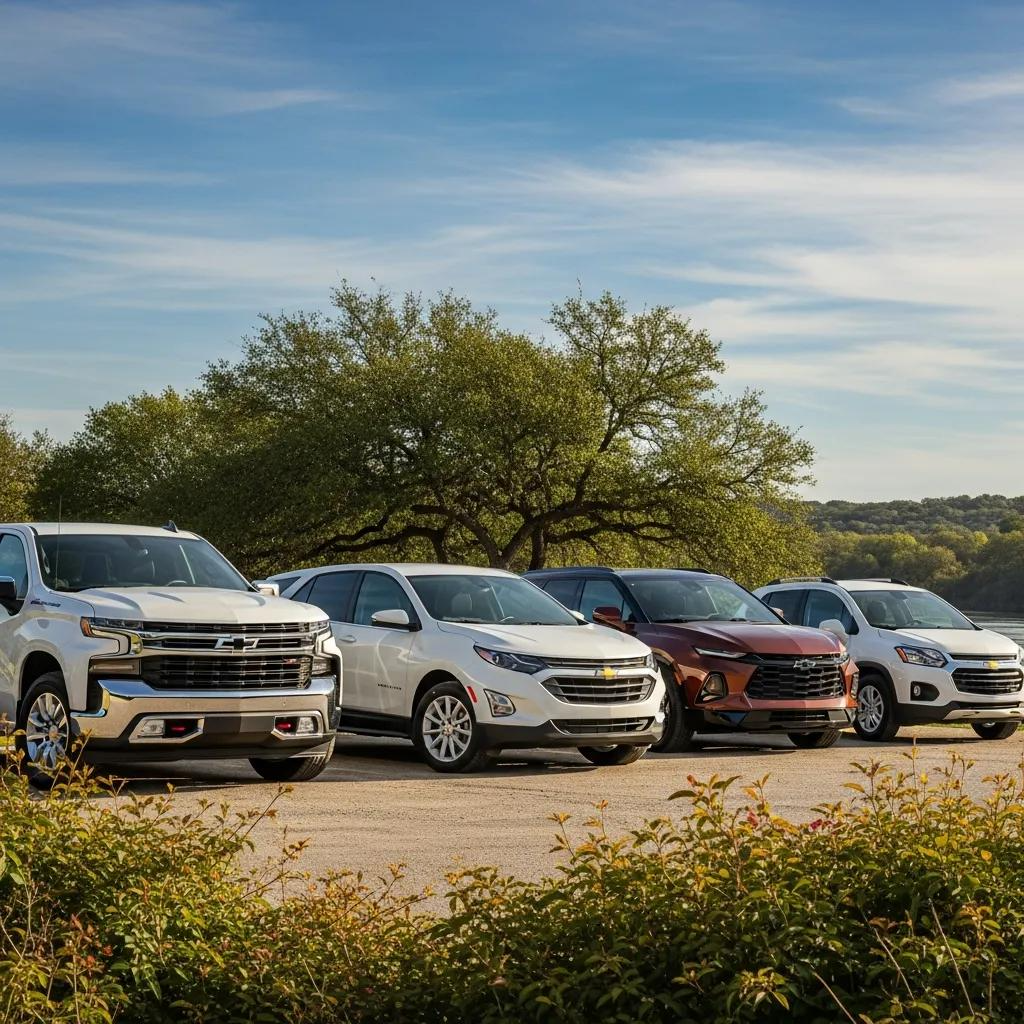
Discover Valmark Chevrolet's Latest Vehicle Inventory
Find Your Next Chevrolet — 2026 Models Available Now at Valmark Chevrolet in New Braunfels, TX At Valmark Chevrolet, we’re excited to show you the 2026 Chevrolet lineup — from rugged trucks and family-ready SUVs to Chevrolet’s newest electric options. Whether you need a dependable daily driver, a roomy family SUV, or a work-ready truck, this guide helps you compare the choices we have here in New Braunfels, TX. As Chevy grows its EV range, we’ll explain how those models work for everyday life and call out financing and special offers that can help make your next Chevrolet more affordable. Which 2026 Chevrolet Models Can You Find at Valmark Chevrolet? We stock a carefully chosen selection of 2026 Chevrolet vehicles built for real life. The models we commonly have in inventory include: 2026 Chevrolet Silverado: A tough, capable truck available with the Duramax Turbo‑Diesel option for strong towing, solid fuel economy, and modern tech on board. 2026 Chevrolet Equinox: A practical, well-appointed SUV that balances comfort and utility — a reliable pick for families and everyday driving. 2026 Chevrolet Blazer: A sportier SUV with bold styling and energetic performance for drivers who want a more engaging ride. 2026 Chevrolet Trax: A compact SUV that’s easy to park, thrifty at the pump, and ideal for city and suburban driving. These 2026 models are in stock at Valmark Chevrolet so drivers in New Braunfels and nearby communities can find the vehicle that fits their needs. Which 2026 Chevrolet Trucks Are Available in New Braunfels? The 2026 Chevrolet Silverado stands out for buyers who need capability and dependability. With the Duramax Turbo‑Diesel option, the Silverado delivers strong power and improved fuel efficiency for towing and heavy hauling. It also includes advanced safety features and available tech like Super Cruise for hands‑free driving on supported highways. Which 2026 Chevrolet SUVs and Crossovers Are Offered? The 2026 Equinox and Blazer are two of our most popular SUV choices. The Equinox delivers roomy seating and strong safety ratings — a smart choice for families. The Blazer offers a more athletic drive and eye-catching looks for drivers who want performance and style. Both come with modern infotainment and driver‑assist systems to keep you connected and confident on the road. How Do Chevrolet Electric Vehicles Fit into Valmark Chevrolet’s 2026 Lineup? Chevrolet’s expanding EV lineup gives drivers more ways to lower emissions and enjoy a different ownership experience. Valmark Chevrolet stocks the latest electric models so you can see range, charging options, and day‑to‑day practicality in person before you buy. What Are the Range and Charging Details for the 2026 Chevrolet Equinox EV? The 2026 Equinox EV is engineered for efficiency and offers an estimated range of up to 300 miles on a full charge. Fast‑charge capability shortens stops on long trips, and onboard management systems help protect battery health and optimize charging for reliable daily use. Why Consider the 2026 Chevrolet Silverado EV and Blazer EV? The Silverado EV brings electric efficiency to a truck without giving up capability — think strong performance with lower operating emissions. The Blazer EV pairs sporty handling with electric power for a spirited drive and a smaller environmental footprint. Both are solid options if you want modern performance and reduced tailpipe emissions. What Specials and Financing Options Does Valmark Chevrolet Offer for 2026 Chevy Models? How Can You Take Advantage of Current New Car Specials at Valmark Chevrolet? We run new‑car specials on select 2026 Chevrolet models that may include cash rebates, special financing, and trade‑in incentives. Visit our website or stop by the dealership to see current offers and learn how to save on your next Chevy. What Financing and Lease Options Are Available for 2026 Chevrolet Vehicles? Valmark Chevrolet offers flexible financing and lease plans to fit different budgets. Our finance team will work with you to find terms and monthly payments that suit your situation, whether you prefer to lease or finance to ownership. Why Choose Valmark Chevrolet in New Braunfels for Your New Chevrolet? What Special Services and Benefits Does Valmark Chevrolet Provide? We stand behind every purchase with services that make ownership easier: scheduled maintenance programs, customer loyalty perks, and community events. Our goal is to support you well after you drive off the lot. How Does Valmark Chevrolet Support Long-Term Maintenance and Service? Our service center is staffed by certified technicians who handle routine maintenance and more complex repairs. We send service reminders and run maintenance promotions to help keep your Chevrolet running smoothly for years. How Do You Schedule a Test Drive or Browse the 2026 Chevrolet Inventory Online? How Do I Schedule a Test Drive at Valmark Chevrolet? Booking a test drive is easy: pick the model you want on our website and choose a convenient time. When you arrive, our team will give you a personalized walkthrough and answer any questions during the drive. How Does Valmark Chevrolet’s Website Help with Online Research and Buying? Our website makes research straightforward — detailed vehicle pages, clear photos, and simple navigation. You can also complete finance applications online to get pre‑approved before your visit, which speeds up the buying process. Model Type Key Features 2026 Chevrolet Silverado Truck Duramax Turbo‑Diesel option, Super Cruise technology, advanced safety features 2026 Chevrolet Equinox SUV Roomy interior, strong safety ratings, modern tech 2026 Chevrolet Blazer SUV Sporty design, energetic performance, advanced connectivity 2026 Chevrolet Trax SUV Compact footprint, excellent fuel efficiency, city‑friendly maneuverability This table highlights key features of the 2026 Chevrolet models we carry at Valmark Chevrolet so you can quickly compare options that match your lifestyle. Valmark Chevrolet is committed to a wide selection of new Chevrolets, attentive customer service, and competitive financing. Focused on innovation and our local community, we’re here to help New Braunfels drivers find the right Chevrolet. Frequently Asked Questions What are the benefits of choosing an electric vehicle from Chevrolet? Choosing a Chevrolet EV like the Equinox EV or Silverado EV can lower your fueling costs and reduce routine maintenance. EVs produce zero tailpipe emissions and include features like regenerative braking and intelligent charging. As charging infrastructure expands, EV ownership is becoming easier and more practical for daily life. How does Valmark Chevrolet ensure customer satisfaction? We focus on personal service and clear communication. Our team listens to your needs, offers tailored financing, and supports you after purchase with service programs and loyalty benefits. Regular follow‑ups and customer feedback help us keep improving the experience for every driver. What should I consider when choosing between leasing and financing a new Chevrolet? Consider your budget, how many miles you drive, and how long you plan to keep the vehicle. Leasing often means lower monthly payments and the ability to switch to newer models more frequently. Financing leads to ownership and can be more cost‑effective if you keep the car long term. We’ll help you weigh the options based on your goals. Are there any incentives for trading in my old vehicle at Valmark Chevrolet? Yes — we offer trade‑in incentives that can include bonuses to lower your purchase price. Our appraisal process aims to give you a fair, competitive trade‑in value. Ask our sales team about current trade‑in promotions when you call or visit. What safety features are included in the 2026 Chevrolet models? 2026 Chevrolet models include features like adaptive cruise control, lane departure warning, automatic emergency braking, and multiple airbags. Many models also offer driver‑assist systems such as rear cross‑traffic alert and blind‑spot monitoring to help keep you safer on the road. How can I stay updated on new arrivals and special offers at Valmark Chevrolet? Sign up for our newsletter on the website to get updates on inventory, promotions, and events. Follow Valmark Chevrolet on social media for real‑time posts, or stop by the dealership to hear about exclusive in‑person offers.
Order It Your Way: How to Factory-Order a New Chevy at Valmark (and When to Just Buy Off the Lot)
You've walked the rows. You found one that's close. Same trim you wanted, wrong color, and it's missing the one feature you swore you'd never buy without again. So now you're doing the math in your head: settle, or wait? There's a third option a lot of San Antonio shoppers never ask about, and it costs nothing to explore. You can factory-order a new Chevy and have it built the way you want it. Same warranty. Same financing. Same incentives at delivery. Just your spec instead of someone else's guess. Here's how it actually works at Valmark Chevy, how long it takes, and when we'd honestly tell you to skip the order and take one off the lot instead. What a factory order actually is A factory order means we submit your exact build, model, trim, engine, paint, interior, packages and standalone options, into Chevrolet's system using one of our allocated build slots. GM schedules it, builds it, and ships it to us. When it lands, it has your name on it. Nobody else can buy it out from under you. That last part matters more than people expect. A truck sitting on the lot is fair game until the paperwork is signed. An ordered unit is yours from the day it's accepted. What it is not: a custom shop. You can't order a Silverado in a color Chevrolet doesn't offer, and you can't mix packages the configurator won't allow. You're picking from the factory menu. It's just that the menu is a lot longer than what any single dealership can physically stock. Order, dealer trade, or buy off the lot? Path Typical wait Best for Trade-off Buy from stock Same day Lease ending soon, vehicle just totaled, current-month incentives You take the build that exists Dealer trade A few days to about two weeks Your exact spec exists somewhere in Texas Limited to what's already built; miles get added in transit Factory order Roughly 6 to 12 weeks, sometimes longer Specific color, package, or configuration nobody stocks You wait, and pricing programs can shift We start with the second option, always. Before we ever submit an order, we search live inventory across the region. If your build is already sitting on a lot in Austin or Houston, a trade gets you driving in days instead of months. Ordering is the answer when the search comes up empty. How long does a Chevy factory order take? Plan on six to twelve weeks from order acceptance to delivery in San Antonio. High-demand configurations and heavy-duty trucks can run longer. Common SUV builds often come in faster. The timeline breaks into three stages. First, the order sits until GM assigns it a production week. Then it's built. Then it ships, usually by rail into Texas and by truck for the last leg. We can give you the status code at any point, and we'd rather text you an honest update than leave you wondering. One seasonal note for anyone reading this in May: order now and you're taking delivery in the thick of summer. That's actually good timing if you're planning a fall road trip, and it's worth building in ventilated front seats while you're at it. Ask anyone who's parked at The Rim in August. Do I pay more for a factory order? No. An ordered vehicle is priced the same way a stocked one is. You're not paying a premium for the privilege of choosing your own options. Rebates and financing offers are the part that moves. Chevrolet's programs change month to month, and in most cases the incentives that apply are the ones in effect the day you take delivery, not the day you order. Sometimes that works in your favor. Occasionally it doesn't. We'll tell you what's on the table right now and what we've seen historically, so you're not guessing. Do I need a deposit? Usually yes, and it's modest. A deposit confirms you're serious before we spend a build allocation, and it's applied to your purchase at delivery. Ask us directly about how ours works before you sign anything. Can I finance or lease an ordered vehicle? Absolutely. You just finalize the financing when the vehicle arrives, since rates and terms are set at delivery. Trade appraisals work the same way. We can give you a ballpark today and a firm number when your new Chevy hits the ground, because your trade will have a few thousand more miles on it by then. Which Chevys are worth ordering Some builds are easy to find in stock. Others practically require an order. Here's where we see it most often. Midsize and full-size trucks Truck buyers are the pickiest, and they should be. Cab and bed combinations, axle ratios, tow packages, bed liners, the specific wheel and tire setup you want. A Colorado in ZR2 spec with the color and interior you actually want is a good candidate for an order, especially if you're planning weekends toward Bandera or the caliche roads west of town. Silverado buyers who need a particular payload package almost always end up ordering. Three-row SUVs Families ordering a Traverse usually care about two things: second-row captain's chairs versus a bench, and which package brings the panoramic roof and the tow rating they want. Stock rarely lines up perfectly with both. A Tahoe is the same story with an added variable, because once you start pairing engine choices with air ride and trailering equipment, the number of trucks matching your exact list gets small fast. Compact and small SUVs These are the ones we can often find without ordering. Still, if you want a specific two-tone roof or interior color on a Trailblazer, or an Equinox in a particular trim with all-wheel drive, an order guarantees it. Neither one takes as long to arrive as a heavy-duty truck. Building your spec for South Texas Once you know you're ordering, spend a little time on the option list. Some boxes are worth checking here that a buyer in Michigan might skip. Ventilated front seats. Non-negotiable if you park outside. Leather and Texas asphalt are a rough pairing from May through September. Lighter interior colors. Black looks great and gets hot. Something to weigh. Trailering package with an integrated brake controller. Cheaper as a factory option than adding it later, and it keeps your wiring clean. Surround-view camera. Worth every dollar in the parking garages downtown and near the Pearl. Remote start. Standard on plenty of trims now, but confirm it's on yours. Three minutes of A/C before you get in changes your whole afternoon. Tire and wheel choices. Big wheels look sharp. If you run I-10 and 1604 daily, a smaller wheel with more sidewall rides better and costs less to replace. When we'd tell you not to order Ordering isn't the right call for everyone, and we'll say so. If your lease matures in three weeks, don't order. If you're driving something that's on borrowed time, don't order. If current-month incentives are unusually strong, taking a stocked vehicle today can save real money compared to waiting and hoping the program repeats. And if you're flexible on color and trim, honestly, we can usually find something within a couple hundred dollars of your ideal build sitting in inventory right now. Hail season is a reason too. Late spring storms roll through Bexar County most years, and an ordered vehicle that arrives in the middle of one is no more protected than any other. Just something to think about if you're on the fence about timing. Quick answers Can anyone place a factory order, or do I have to be a repeat customer? Anyone can. Walk in, call, or start online. Can I change my order after it's submitted? Sometimes, if the vehicle hasn't been scheduled for production yet. Once it's in the build queue, changes usually mean starting over. Can I cancel? Talk to us early. Policies vary depending on where the order is in the process, so ask before you place it. Will the vehicle have miles on it when it arrives? A handful, from the assembly line and transport handling. That's normal and it's still a new vehicle. Start your build with Valmark Chevy Bring us a screenshot of the build you configured at two in the morning. Seriously. We'll check it against live inventory across the region first, tell you straight whether we can find it or whether an order makes more sense, and give you a realistic delivery window instead of a hopeful one. Call Valmark Chevy, message us through the site, or stop by and ask for someone who's placed orders before. Browse our new Chevrolet inventory while you're here, and if the exact one you want isn't on the lot, we'll go get it built.
Texas Summer Is Coming: The New Chevy Features San Antonio Drivers Should Shop For Now
You already know what's coming. By the second week of June, the asphalt on Loop 1604 is hot enough to soften shoe rubber, and a car parked in an open lot at La Cantera for two hours turns into a convection oven. San Antonio summers don't sneak up on anybody. They just show up and stay for four months. So if you're shopping a new Chevy right now, in early May, you're shopping at exactly the right time. The features that matter in a Texas summer are not the ones that get top billing in a commercial. Nobody advertises the rear window sunshade. But you'll think about it every single day from June through September. Here's what we'd tell you to look for, model by model, standing right here on the lot. Ventilated Front Seats: The One Feature Texans Regret Skipping Heated seats get all the marketing. In South Texas, you might use them twelve days a year. Ventilated seats, sometimes called cooled seats, pull air through perforations in the leather and move it across your back and legs. On a 101-degree afternoon, that's the difference between arriving at a meeting composed and arriving at a meeting with a shirt you have to peel off. Ventilated front seats show up on higher trims across the Chevy lineup. On a Tahoe, look at RST, Premier and High Country. On the Traverse, they land on the upper trims alongside leather-appointed seating. The Equinox offers them on select configurations too, which surprises a lot of shoppers who assume it's a large-SUV-only feature. Here's the honest caveat: availability moves around by model year and by build. Not every unit on the lot has them. Ask us to pull the window sticker before you fall in love with a specific truck or SUV, because that's the fastest way to confirm it in thirty seconds. Remote Start, and Why the App Version Matters More Every new Chevy we stock has push-button remote start on the key fob. Great feature. Limited range, though. If you're on the third floor of a downtown parking garage and your car is on the ground level, that fob isn't reaching it. Remote start through the myChevrolet mobile app works from anywhere you have a signal, as long as your connected services trial or plan is active. Start the truck from your desk five minutes before you walk out. The A/C has already dumped the worst of the heat out of the cabin by the time you open the door. New vehicles come with a trial period of connected services, and we'll walk you through setting up the app before you leave the lot. Takes about ten minutes. One tip most people miss: set your climate control to auto and leave the temperature at 68 or so before you shut the vehicle off. Remote start replays your last settings. If you left it on floor vents only, that's what you get. Glass, Shades and the Texas Tint Law Rear passengers cook faster than front passengers. Sun coming through side glass at 4 p.m. on US-281 hits kids in car seats directly. Look for these on the build sheet: Deep-tinted rear glass, standard on most Chevy SUVs from mid-trim up, and a real temperature difference in the second and third rows. Manual rear door sunshades, available on some larger models. Cheap-feeling, wildly effective. Panoramic sunroof with a power shade. Beautiful in February. Make sure the shade is opaque, not mesh, before you buy it for a Texas summer. If you're planning to add aftermarket tint, know the rule: in Texas, front side windows must allow at least 25 percent of light through, and the windshield strip is limited to the AS-1 line or the top five inches. Rear windows on an SUV or truck can go darker. Plenty of San Antonio shops will do it right. Plenty will not. Rear Climate Vents and Tri-Zone Control Three-row buyers, listen to this one. A third row with no dedicated vents is a third row nobody wants to sit in from May to October. The Traverse and Tahoe both handle rear climate properly with dedicated rear controls and overhead or pillar vents that actually reach the back seats. If you regularly haul more than four people, do not compromise here. Smaller SUVs like the Trailblazer and Equinox get rear-facing floor vents on most trims. For a two-row cabin driving around Alamo Heights or out to Boerne, that's plenty. Quick Comparison: What Fits Your Summer Model Rows Max Towing (up to) Best For Trailblazer 2 1,000 lbs Commuters, first-time buyers, tight downtown parking Equinox 2 1,500 lbs Small families, daily 1604 driving, strong fuel economy Traverse 3 5,000 lbs Carpool duty plus a boat or small camper Tahoe 3 8,400 lbs Big families, serious towing, long highway hauls Colorado 2 (crew cab) 7,700 lbs Weekend trailers, job sites, Hill Country trails Towing numbers depend on cab, drivetrain and equipment. Ask us to confirm the rating on the exact unit you're looking at. Towing in 100-Degree Heat Is a Different Job Pulling a boat up to Canyon Lake in April is easy. Pulling that same boat in mid-July with the A/C on max and a headwind on I-10 asks more of the cooling system. If towing is part of your summer, spec the trailering package. It's not just a hitch. You're getting upgraded cooling, a trailer brake controller on many builds, and the integrated trailering camera views that make backing down a ramp at Canyon Lake far less stressful. The Colorado is the sweet spot for a lot of San Antonio buyers here. It'll pull a good-sized travel trailer, it fits in a home garage, and it doesn't punish you on fuel during the week when it's just you and a laptop bag. Straight Answers to Questions We Get Every May Which new Chevy is best for Texas heat? For most San Antonio drivers, a mid or upper trim with ventilated front seats, deep-tinted rear glass and app-based remote start. That combination exists on Equinox, Traverse and Tahoe. If budget is the priority, a Trailblazer with remote start and a good aftermarket tint job gets you most of the way there for a lot less money. Is May a good time to buy a new Chevy in San Antonio? Yes. Spring inventory is deep, Memorial Day incentives typically arrive late in the month, and you get the vehicle before the worst of the heat instead of after. Buying in September means you paid for a summer you spent in your old car. Do I need all-wheel drive here? Not for weather. San Antonio doesn't ask for it. AWD helps if you're on caliche roads, boat ramps or Hill Country trails, or if you want the extra confidence during a hard spring downpour on 410. Front-wheel drive is fine for most commuters and usually returns better fuel economy. How hot does a parked car actually get here? Interior temperatures in a closed vehicle can climb past 130 degrees on a 100-degree day, and dashboard surfaces read higher than that. It's why remote start and a windshield sunshade aren't luxuries in this market. They're basic equipment. Come Look Before June We've got new Chevrolet trucks and SUVs on the ground right now, and our team will happily stand in the lot with you and check window stickers for ventilated seats, rear climate controls and trailering packages until you find the exact build you want. Bring your trade, bring your questions, bring the car seats if you want to test-fit them. Stop by Valmark Chevy, browse the new inventory online, or call us to set up a test drive. Let's get you into something cool before the first triple-digit day shows up.
Texas-Built, San Antonio Tough: Meet the Chevy Silverado 1500
The 2025 Chevrolet Silverado 1500 is more than a truck—it’s a trusted partner for work, play, and everything in between. From the bustling streets of San Antonio to the rugged Hill Country, Silverado delivers power, performance, and innovation that make every mile count. Visit ValMark Chevrolet in New Braunfels to see why Texas drivers swear by Silverado. Power That Never Quits Choose from a lineup of proven engines that define truck capability: 2.7L TurboMax™ — 310 hp and 430 lb-ft of torque for confident towing. 5.3L EcoTec3 V8 — A perfect blend of muscle and efficiency. 6.2L V8 — For those who demand maximum power and presence. Duramax® 3.0L Turbo-Diesel — Unmatched torque for towing and highway economy. With up to 13,300 lbs of towing capacity and advanced trailer tech, Silverado is ready for everything from job sites to weekend getaways on Canyon Lake. Interior Comfort, Texas Style The Silverado’s cabin combines rugged functionality with upscale design. Available leather seating, dual-zone climate control, and a massive 13.4-inch infotainment touchscreen make this truck feel as refined as it is capable. Every control is within reach, and the cabin is whisper-quiet even when towing heavy loads across I-10. Technology That Works Smarter Stay connected with Google Built-In, wireless Apple CarPlay®, Android Auto™, and available Super Cruise™ for hands-free highway driving. The Silverado’s advanced trailering system features multiple camera angles, trailer lighting diagnostics, and hitch guidance—all designed to make towing easier and safer. Safety Built for San Antonio Roads Every Silverado includes Chevy Safety Assist with Forward Collision Alert, Lane Keep Assist, Automatic Emergency Braking, and IntelliBeam auto high beams. Optional features like Rear Cross Traffic Braking and HD Surround Vision give you confidence in crowded parking lots and tight Hill Country backroads alike. Trim Levels Made for Texans Work Truck (WT): Built to get the job done, no frills required. Custom: Sporty style and value-driven features. LT: Comfort and connectivity meet rugged utility. RST: Urban-ready design with powerful V8 options. LTZ: Premium comfort and advanced towing tech. High Country: Top-of-the-line refinement and capability. Why Buy from ValMark Chevrolet Family-owned, locally trusted, and proud to serve San Antonio drivers, ValMark Chevrolet is where Texans find the trucks they can count on. Whether it’s sales, service, or financing, our team is here to make your Silverado experience seamless and satisfying. Find Your Silverado 1500 Today Browse our Silverado 1500 inventory, apply for financing, or schedule your test drive today. Strength, style, and Texas heritage are waiting for you at ValMark Chevrolet.
Built for San Antonio Adventures: The Chevy Colorado
The 2025 Chevrolet Colorado strikes the perfect balance between capability and convenience. Designed for Texas-sized versatility, this mid-size truck brings power, technology, and off-road confidence whether you’re hauling gear through San Antonio or exploring the Hill Country backroads. See it today at ValMark Chevrolet. Performance That Pulls Its Weight Colorado’s standard 2.7L Turbo engine delivers up to 310 horsepower and 430 lb-ft of torque —making it one of the most powerful trucks in its class. Paired with an 8-speed automatic transmission and available four-wheel drive, Colorado handles both city commutes and country trails with confidence. For those who like to get dirty, trims like the ZR2 feature Multimatic DSSV dampers, skid plates, and up to 10.7 inches of ground clearance—perfect for weekends near Boerne or Canyon Lake. Technology That Works Smarter Inside, you’ll find an intuitive digital cockpit with an 11.3-inch infotainment screen and an 8-inch digital cluster. Google Built-In, wireless Apple CarPlay®, and Android Auto™ keep you connected wherever your day takes you. Add available off-road performance displays to monitor pitch, roll, and traction in real time. Interior Comfort and Design Don’t let the rugged exterior fool you—Colorado’s cabin offers premium comfort. Available leather-appointed seats, soft-touch materials, and a quiet ride make every drive enjoyable. The rear seats fold flat for extra cargo space, while clever storage under the seat keeps essentials secure. Safety for Every Mile Standard Chevy Safety Assist includes Forward Collision Alert, Automatic Emergency Braking, Lane Keep Assist, and more. With available HD Surround Vision, Rear Park Assist, and Blind Zone Steering Assist, you’ll navigate tight Austin and San Antonio streets like a pro. Trim Options WT: Built for the essentials with modern connectivity. LT: Balanced for comfort and practicality. Trail Boss: Off-road stance and all-terrain capability. Z71: Adventure-ready with sporty design touches. ZR2: The ultimate off-road performer. Why Buy from ValMark Chevrolet We’re proud to serve Texas drivers with honesty, expertise, and hometown hospitality. From the right financing plan to service that keeps you moving, ValMark Chevrolet is your go-to for everything Chevy in San Antonio. Explore our Colorado inventory and get pre-approved for your next adventure today.